

Indonesia’s free-trade island grows faster than the national economy as manufacturing, logistics and investment drive a post-oil expansion.
Batam, gokepri – For years Batam was known mainly as Indonesia’s offshore industrial outpost. Now the island city is emerging as something larger: the fastest-growing economy in the Riau Islands province.
Data released by Indonesia’s Central Statistics Agency (BPS) show that Batam’s economy expanded by 6.76 percent year-on-year in 2025 when the oil and gas sector is excluded. The figure is higher than the overall economic growth of the Riau Islands province, which reached 5.88 percent, and above Indonesia’s national growth rate of 5.11 percent.
The performance places Batam firmly at the top among districts and cities in the province. Bintan recorded economic growth of 6.43 percent, followed by Karimun with 5.44 percent. Tanjungpinang grew 3.31 percent, Lingga 3.53 percent, and the Anambas Islands 2.87 percent. Natuna, heavily dependent on certain sectors, experienced a contraction of 1.61 percent.
Batam’s economic dominance is also visible in its scale. In 2025 the city contributed 66.44 percent of the entire Riau Islands economy, making it by far the province’s main economic engine.
Local officials say the expansion reflects a structural shift away from reliance on extractive industries. Batam’s growth is increasingly driven by manufacturing, trade, logistics, construction and foreign investment.
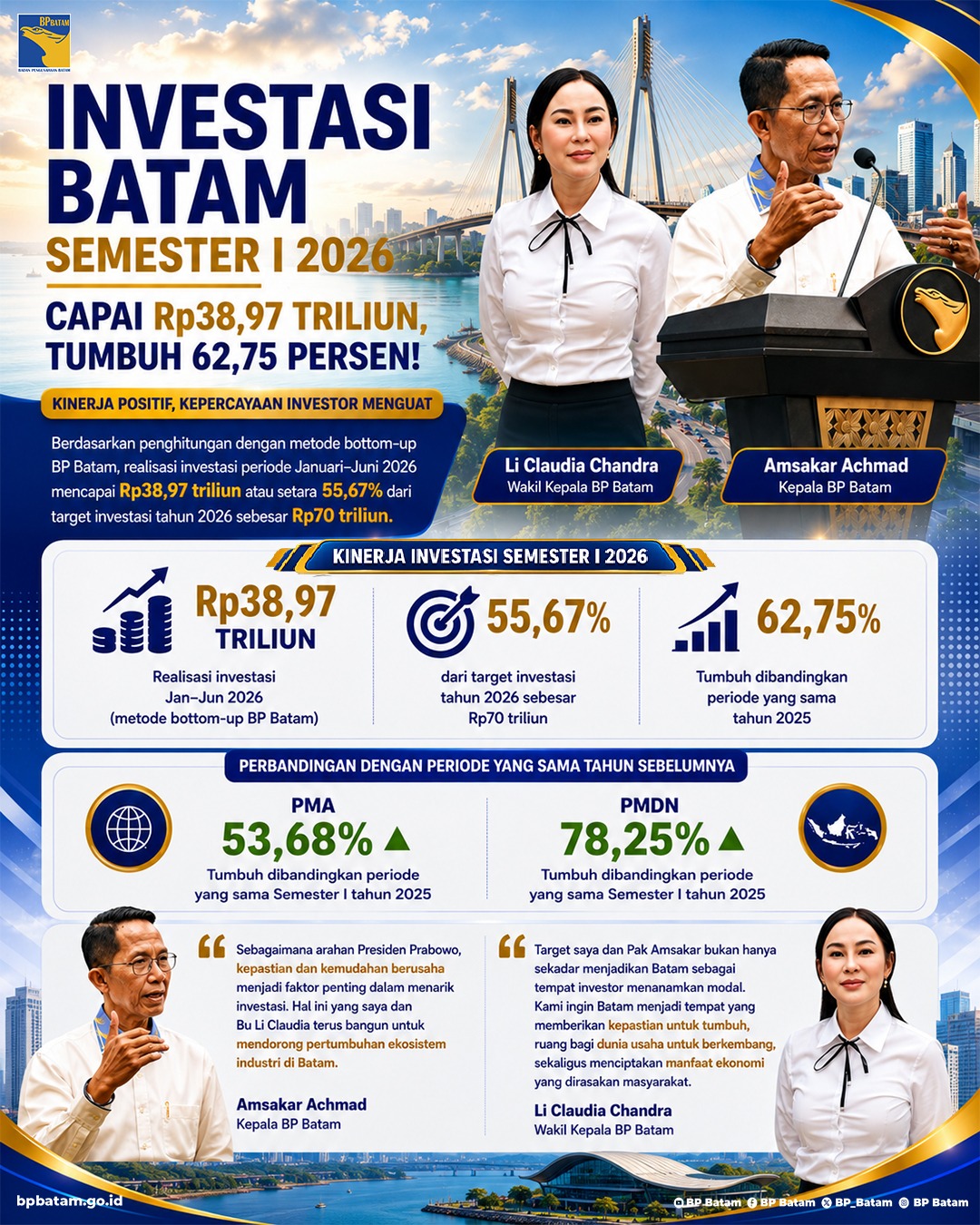
Batam is governed by a dual leadership structure: Amsakar Achmad serves as mayor while also heading BP Batam, the government agency responsible for managing the island’s free trade zone and industrial development. His deputy, Li Claudia Chandra, simultaneously serves as vice mayor and deputy head of BP Batam. Together they oversee policies aimed at strengthening Batam’s role as an industrial and investment hub in western Indonesia.
“Batam’s economic growth of 6.76 percent without oil and gas shows that the city’s economic engine is powered by productive sectors such as manufacturing, trade, logistics and rising investment,” said Fary Djemy Francis, Deputy for Investment and Business Development at the Batam Indonesia Free Zone Authority (BP Batam). “This proves that Batam is developing into a more competitive international industrial and trade center.”
The measurement excluding oil and gas, he added, provides a clearer picture of the local economy. The energy sector is often volatile because it depends on global prices and production levels.
“Oil and gas are strongly influenced by global energy prices and production volumes,” Fary said. “That fluctuation often does not reflect the real activity of the local economy. By looking at growth without oil and gas, we can see more clearly that Batam’s economy grows because of industry, trade and investment.”
Batam’s economic geography explains much of its momentum. Located just 20 kilometers south of Singapore and close to Malaysia, the island sits directly on one of the world’s busiest shipping routes through the Malacca Strait. For decades Indonesia has tried to turn that location into an advantage through special economic policies and industrial estates.
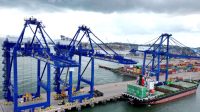
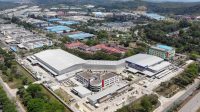
Today those industrial zones host hundreds of electronics, shipbuilding, precision engineering and logistics companies. Expanding ports, warehouses and transportation networks are reinforcing Batam’s role as a regional manufacturing and distribution hub.
Fary said the city’s strategic location, combined with continuing industrial development and investment incentives, helps maintain that momentum. Infrastructure improvements and international logistics connectivity also strengthen Batam’s appeal for investors.
“Batam has geographic advantages and a strong industrial ecosystem,” he said. “With infrastructure support, investment facilitation and international logistics connectivity, Batam is strengthening its role as a globally competitive investment and industrial hub.”
For Indonesia, the island’s rise has broader implications. Batam has long been viewed as a testing ground for export-oriented manufacturing and cross-border trade. Its proximity to Singapore gives companies access to global supply chains while operating within Indonesia’s labour market.
That formula appears to be gaining renewed traction. The surge in manufacturing and logistics activity suggests that Batam is consolidating its position as a gateway for international investment in western Indonesia.
Whether the growth can be sustained will depend on several factors: the stability of global trade, continued infrastructure expansion and the ability of local authorities to keep attracting foreign capital. For now, however, the island’s economy is no longer waiting for the oil market. It is building its own engines of growth. ***
Read Next: Sembcorp Returns to Batam with Ambitious Green Industrial Projects
Read more from us Google News