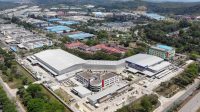


Massive AI dan data centre investment alone is not enough. Singapore says local talent must move up the value chain.
Singapore, GOKEPRI – Singapore believes Batam’s rapid expansion as a data centre and artificial intelligence hub will only deliver long-term benefits if local workers gain the skills needed to move beyond operational roles. Education, training and technology transfer, rather than infrastructure alone, are seen as the next challenge.
The issue surfaced during the 22nd Indonesian Journalists’ Visit Programme (IJVP) at Singapore’s Ministry of Foreign Affairs on 16 July 2026. Responding to a question about concerns that Batam could become merely an operational backyard for Singapore’s digital industry, Minister of State for Foreign Affairs Zhulkarnain Abdul Rahim argued that human capital would determine whether the city captures greater value from incoming investment.
“I visited the data centre in Batam and was impressed by its scale and the hyperscalers operating there,” Zhulkarnain said.
Batam has attracted billions of dollars in investment for data centres and AI infrastructure in recent years, driven by its proximity to Singapore, relatively lower operating costs, and growing power capacity. The rapid expansion has also raised questions about whether strategic expertise and high-value jobs will remain concentrated in Singapore.
Zhulkarnain acknowledged that data centres require significant land, electricity and water, while creating employment opportunities in operations and maintenance.
“The next leap is to move up the value chain,” he said.
He noted that Singapore had experienced a similar transition. The country began as a manufacturing and transshipment economy before investing heavily in education and workforce development to support higher-value industries.
That experience, he argued, offers a lesson for Batam.
Zhulkarnain stressed that technology transfer cannot rely solely on foreign investors. Governments, educational institutions and workers must also prepare themselves to absorb advanced knowledge and expertise.
“It is a function not just of government, but also of the people, to make sure that they scale up and skill up,” he said.
He added that multinational technology companies investing in Batam would be more likely to transfer advanced capabilities if a skilled workforce is already available.
Rather than waiting for companies to bring expertise, ASEAN countries should actively prepare their workers through education and vocational training, he said.
AI Creates a New Opportunity
Zhulkarnain described artificial intelligence as the next major technological wave, comparable to previous industrial transformations.
“The next wave will be AI. We do not only need AI users, but AI developers,” he said.
He warned that Southeast Asia risks facing a widening digital divide if workers are unable to adapt to AI technologies. Those who fail to acquire new skills could be left behind as industries increasingly adopt AI-driven systems.
For Batam, its close proximity to Singapore offers opportunities for greater collaboration in education, workforce development and professional training, he said.
Learning Beyond the Classroom
Zhulkarnain pointed to Singapore’s NUS Overseas Colleges programme as an example of how international exposure can help build innovation ecosystems. The programme sends students to technology hubs such as Silicon Valley, Paris and Germany to work with startups before returning to Singapore.
One graduate of the programme later co-founded online marketplace Carousell, illustrating how overseas experience can translate into successful technology businesses.
He suggested ASEAN could develop more initiatives that expose young professionals to international industries before bringing their knowledge back to the region.
With ASEAN’s combined population approaching 700 million people, Zhulkarnain said strengthening human capital remains the region’s greatest opportunity to compete in the global digital economy. Education and continuous skills development, rather than physical infrastructure alone, will determine whether Batam evolves from a data centre location into a centre for technology innovation.
Read more: Batam’s quiet economic surge
Read more from us Google News